
The short answer
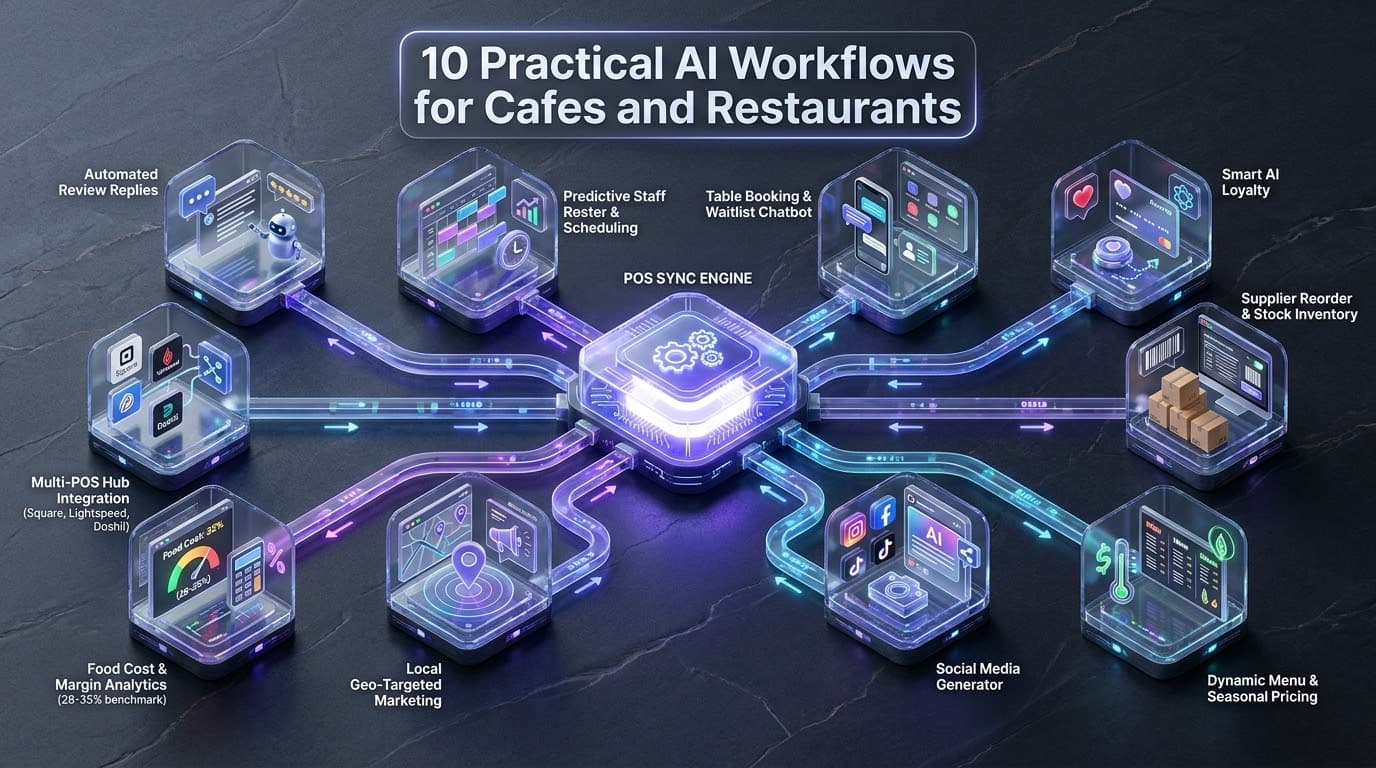
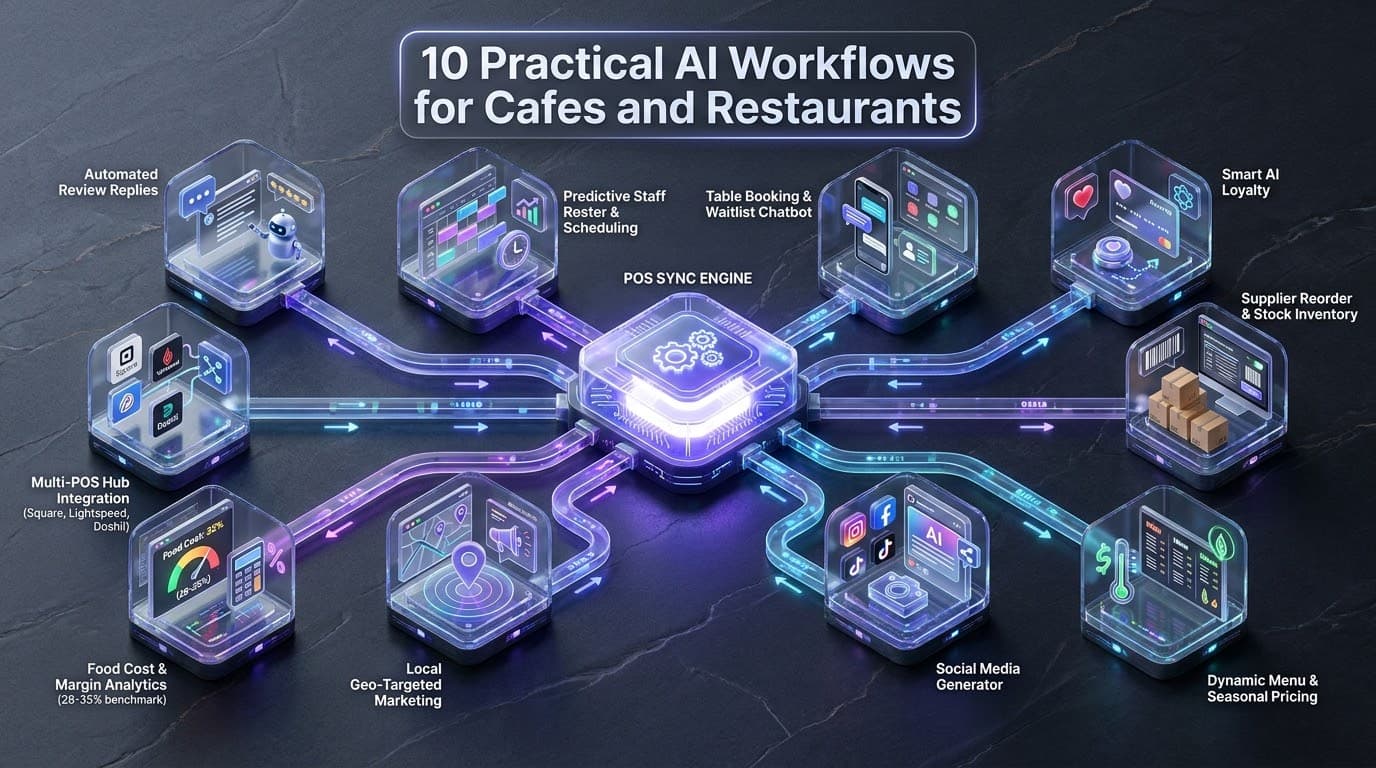
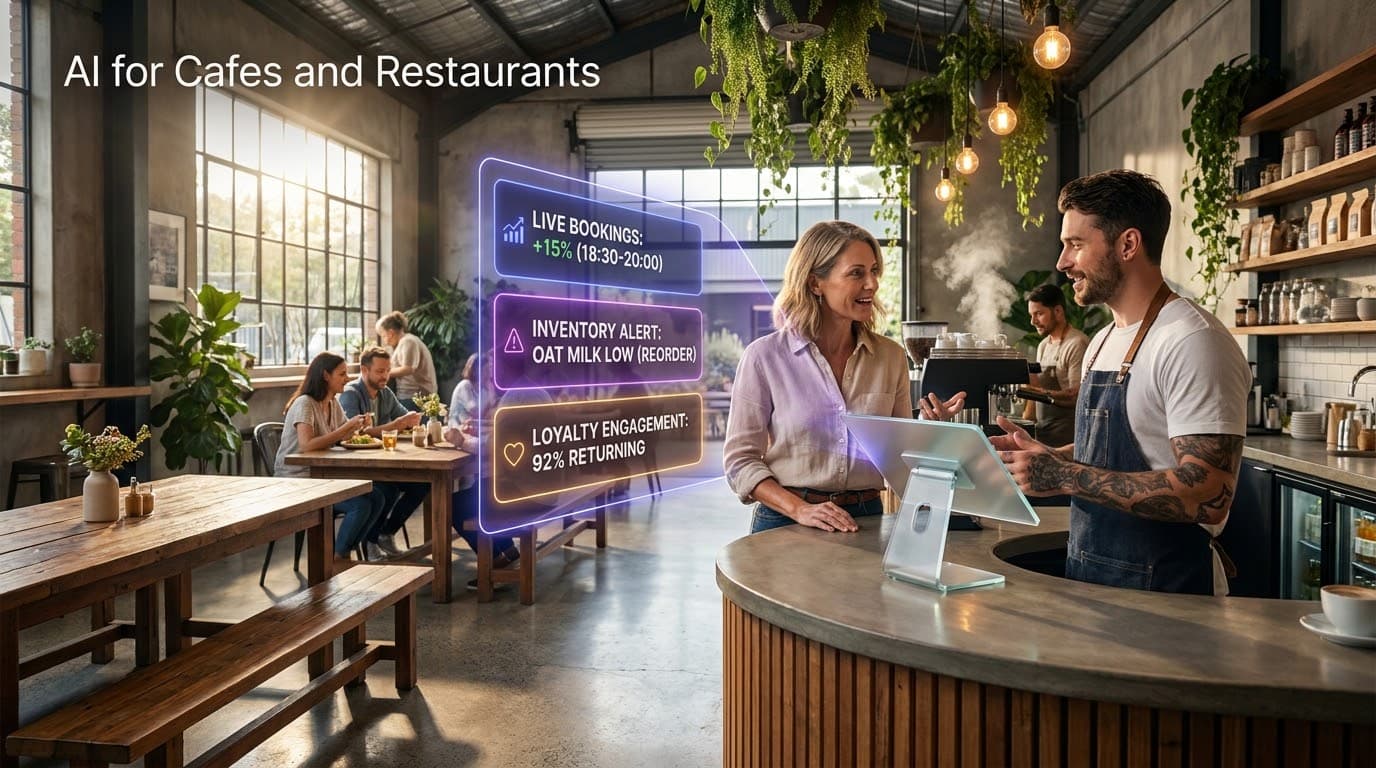
AI for independent cafes and restaurants is not enterprise software. It is ten contained workflows — review replies, staff scheduling, table booking chatbots, loyalty programs, supplier reorders, menu updates, social content, and local marketing — all accessible to a single-site venue today, without a tech team and without replacing your existing POS.
What you'll take away
- 10 practical AI workflows for independent venue operators
- AU platform integrations: Square, Lightspeed, Doshii, 7shifts
- A framework for evaluating AI tools before you subscribe
- Privacy and compliance context for loyalty programs and chatbots
- 20 FAQs covering the most common owner-operator questions
AI helps independent cafes and restaurants automate review replies, staff scheduling, table bookings, loyalty programs, supplier reorders, menu updates, social media content, and local marketing campaigns. These workflows reduce manual hours, protect thin margins, and improve customer retention — without requiring a tech team. Tools integrate with Square, Lightspeed, and Doshii for AU operators.
Why AI Is Now Relevant for Independent Cafes and Restaurants
Two years ago, most AI tools were designed for chains with IT departments and five-figure software budgets. That has changed. Setup time for practical AI tools is now measured in hours, not months, and pricing has moved to flat monthly subscriptions accessible to a single-site venue.
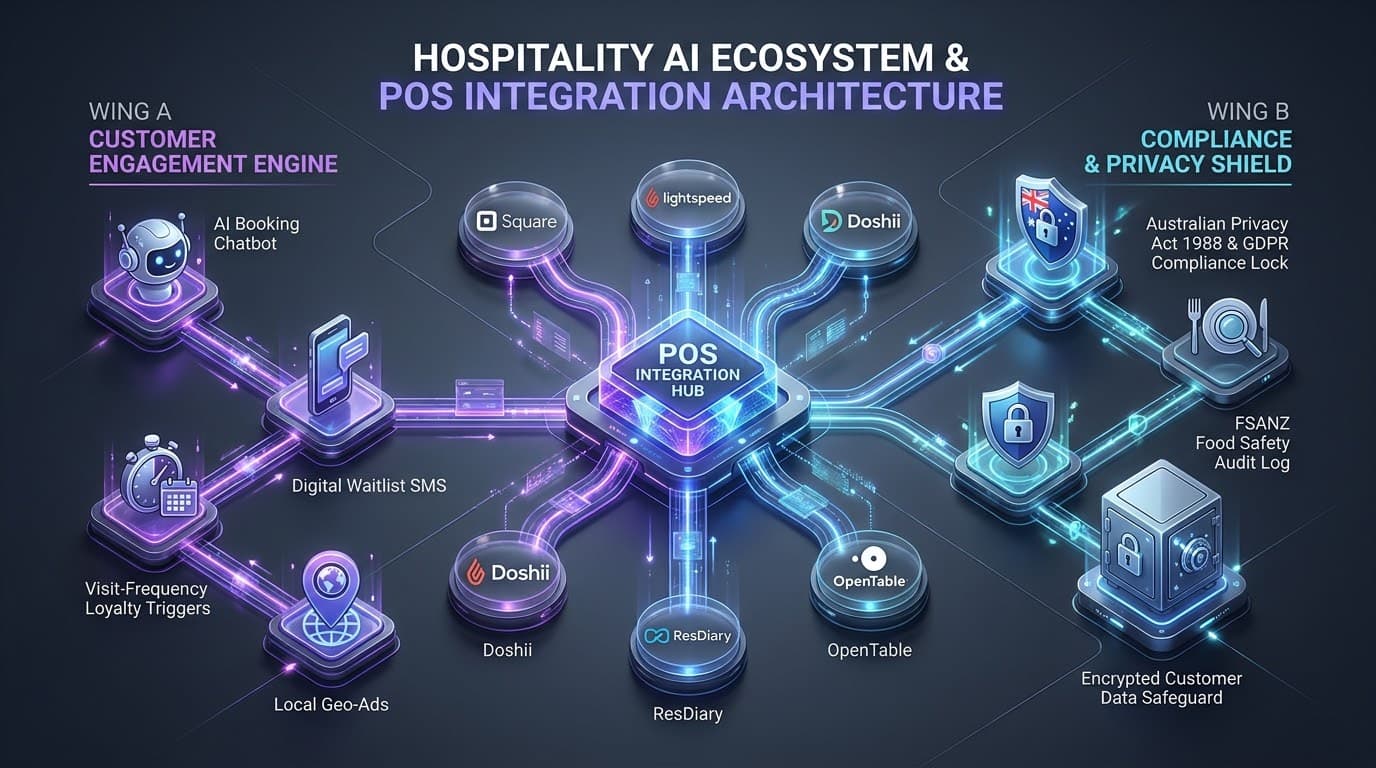
The real margin threat for independent operators is not competition from the café down the road. It is labour cost and customer churn. A casual-heavy roster that takes two hours to build every week and a loyalty program that lives on a punch card are both solvable with tools that connect directly to the POS systems most independent venues already run. Square and Lightspeed, the two most widely used POS platforms among Australian independent venues, both support AI integrations either natively or via third-party connections.
A 2026 VistaPrint survey of food and beverage businesses found that 47% already use some form of AI in their operations, and 83% of those report it helps them compete with larger chains. The shift is already underway. The question for most owner-operators is not whether to start, but where.
Start with one workflow, get it running well, then add the next — not a transformation, not nine tools, not a new operating model.
For venues exploring AI consulting for hospitality, the entry point is almost always one contained workflow rather than a full technology overhaul.
1. Automated Review Replies — Protecting Your Reputation Without the Grind
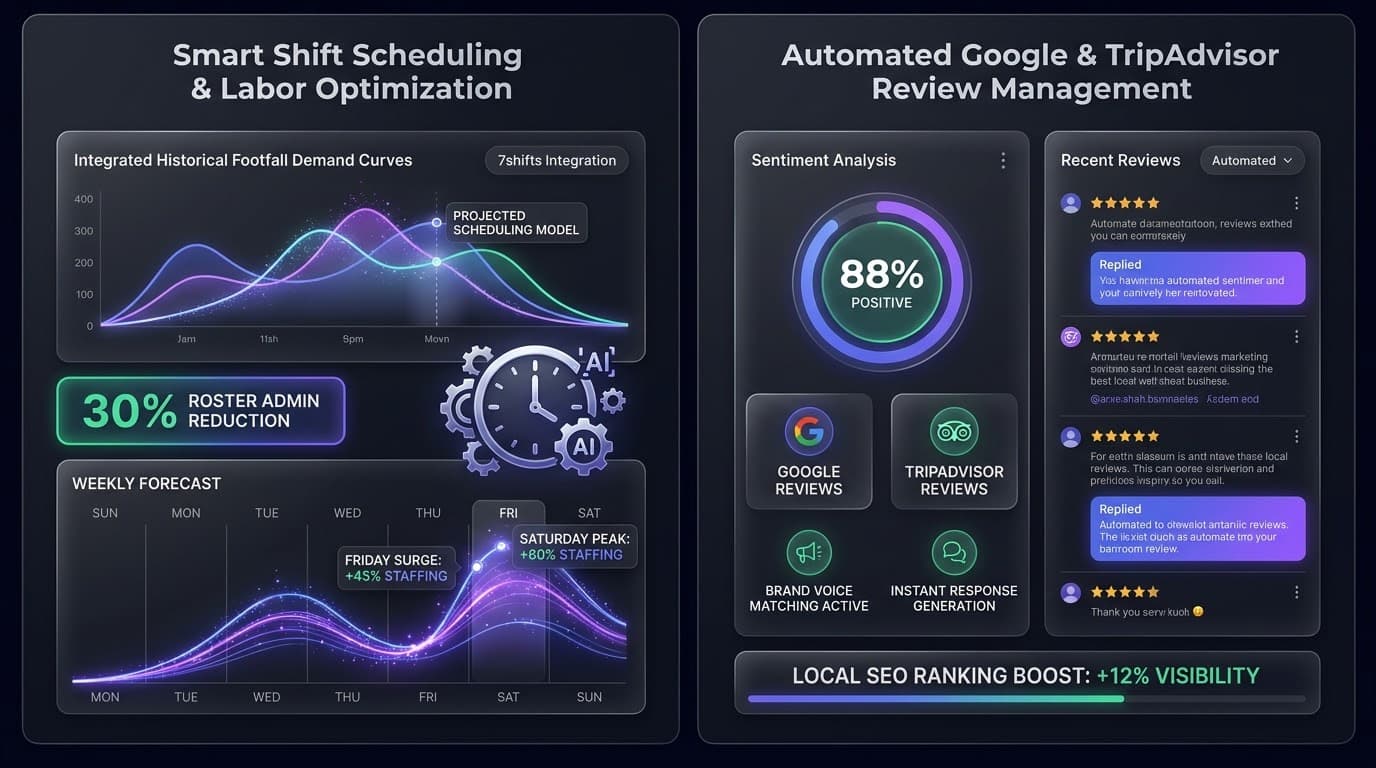
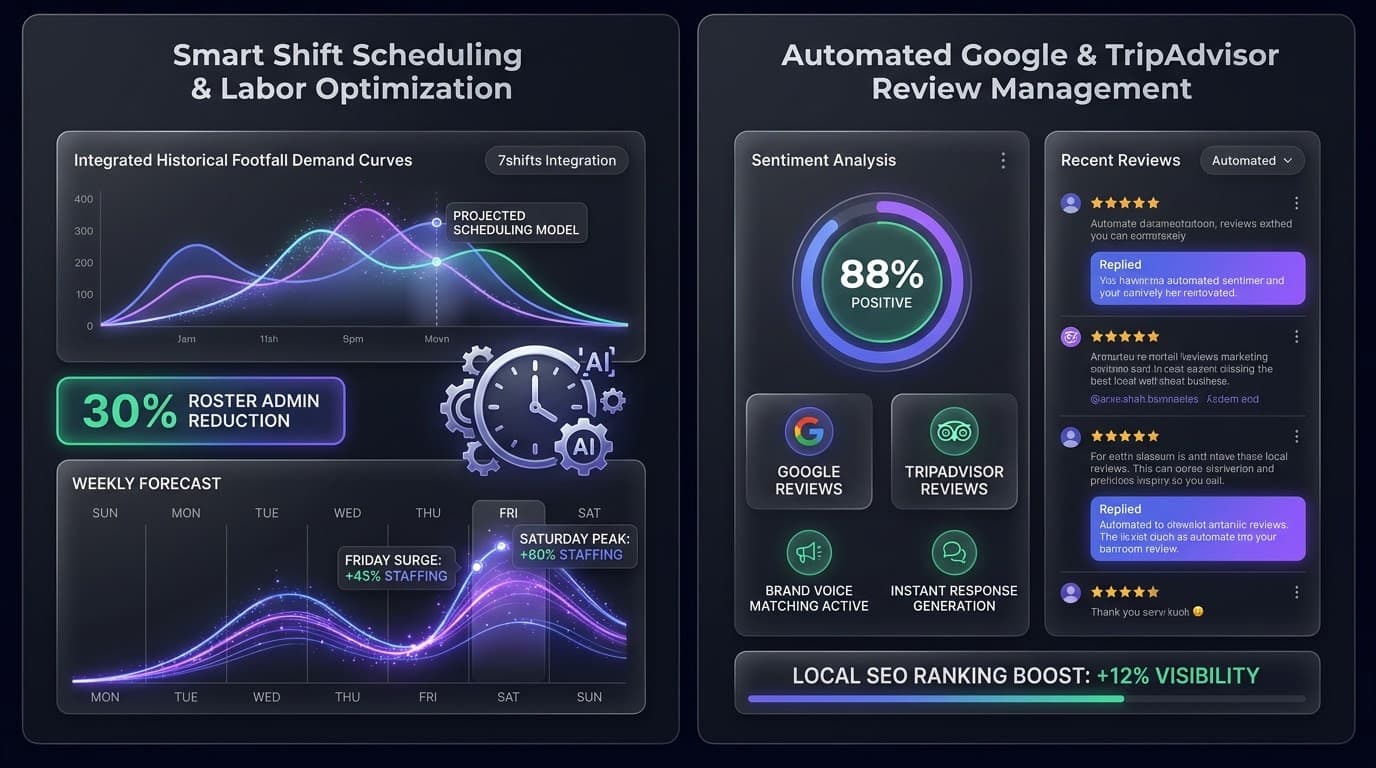
Review management is the single most common entry point for AI in hospitality, and for good reason. The workflow runs like this: a customer leaves a review on Google or TripAdvisor, AI drafts a reply that matches your venue's voice, you approve it or set it to auto-post, and positive reviewers are triggered to share again.
Google rewards venues that respond consistently to reviews. Active engagement with reviews is a confirmed signal in Google's local search ranking algorithm, which means a backlog of unanswered reviews is not just a reputation gap, it is a visibility gap.
What AI does here is different from copy-pasting a generic thank-you. It runs sentiment analysis on the review content, matches tone to your brand voice, and personalises the response. A one-star complaint about slow service gets a different reply from a five-star post about the eggs benedict.
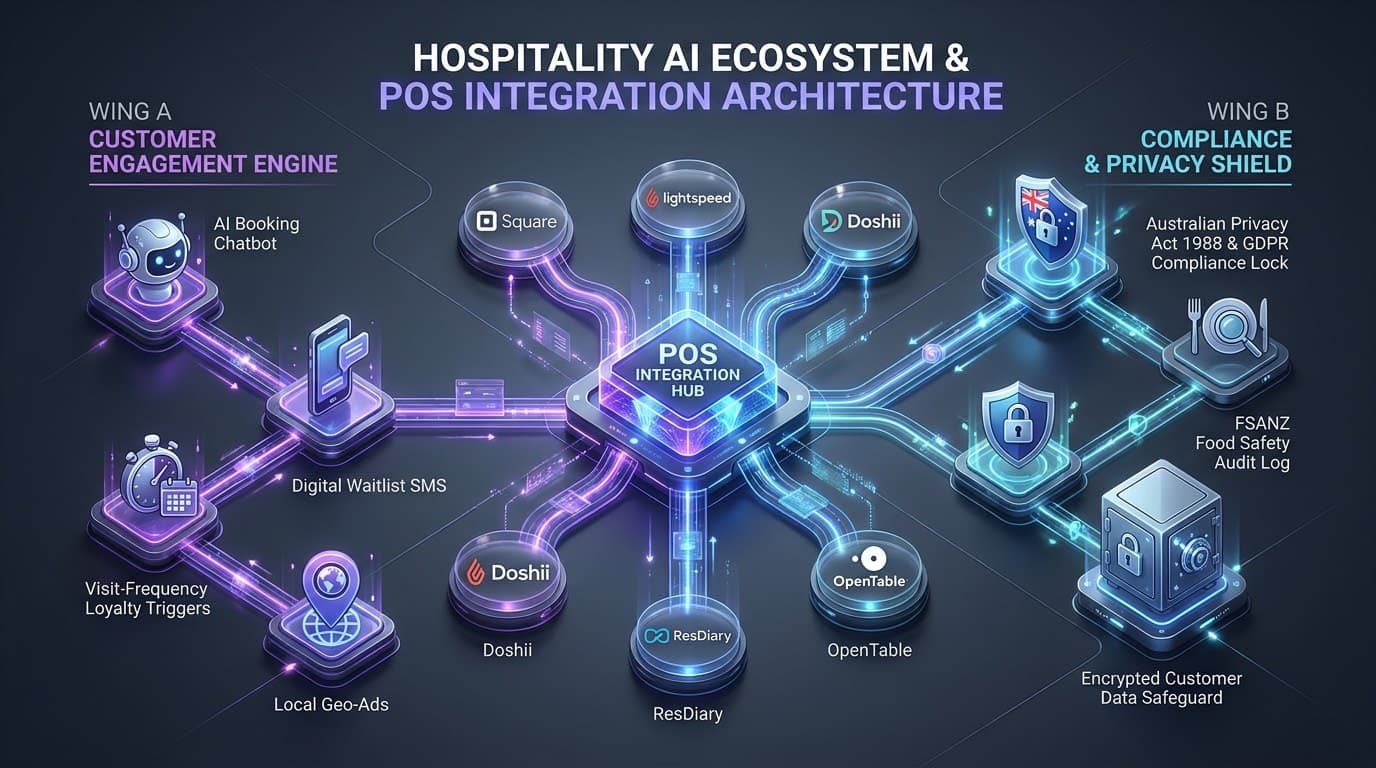
In Australia, this integrates with Google Business Profile, which both Square and Lightspeed connect to via the Doshii ecosystem. The owner still sets the voice rules and handles escalations. AI handles the volume.
2. Staff Scheduling AI — Less Roster Admin, Better Shift Coverage
Building a roster for a casual-heavy hospitality team on a Sunday night is one of the most draining administrative tasks in the industry. AI scheduling tools change the shape of that task without removing the manager from the decision.
The workflow: the tool pulls historical sales data and upcoming booking numbers, drafts a shift schedule based on predicted demand, the manager reviews and adjusts, and staff receive automated notifications. The Friday and Saturday surge is factored in. So are the known sick-day patterns from your past 12 months of data.
FSR Magazine's 2026 Tech Forecast reports that AI scheduling tools are associated with approximately 30% reductions in time spent building rotas. For a venue manager spending two hours on a weekly roster, that is a meaningful return.
7shifts is one named entity in this category, used widely across Australian and North American hospitality venues. The principle is the same across tools: AI suggests, manager decides. Staff find out from their manager, not from a bot.
3. Table Booking Chatbot and Waitlist Management — Never Miss a Reservation
A customer visits your website or Instagram at 11pm. Without a chatbot, they either find a phone number they cannot call or they move on. With one, they book a table, get a confirmation via SMS or email, receive a reminder 24 hours before their reservation, and if they do not show, a follow-up is triggered automatically.
The workflow is: customer opens the chat widget on your website or social page, the chatbot answers questions about the menu, hours, and availability, accepts the booking or adds them to a digital waitlist, and sends all the right messages from that point without anyone on your team doing anything manually.
Waitlist management is the underrated half of this. Rather than handing walk-ins a buzzer-pager, AI queues them digitally and sends an SMS when their table is ready. This also gives you a contact record for every walk-in.
In Australia, these tools integrate with reservation platforms including OpenTable and ResDiary, and connect to most AU POS systems via Doshii middleware. One honest caveat: the chatbot needs to be trained on your specific menu, hours, and policies before it goes live. It is not plug-and-play on day one, but the setup is a one-time task, not an ongoing burden.
Not sure which workflow fits your venue? Find out free.
Get a free AI Tune Score — a quick snapshot of where automation can save you the most time.
4. AI Loyalty Programs — Keeping Regulars Without a Stamp Card
A paper stamp card tells you nothing about your customers. An AI-assisted loyalty program tells you which customers visit twice a week, which ones have not been in for three weeks, and which ones tend to spend more when they receive a specific type of offer.
The workflow: a customer opts in at the point of sale, their purchases are tracked via POS integration, AI identifies visit frequency patterns, and a personalised trigger fires when a behaviour threshold is met. “You haven't visited in three weeks, here's a free coffee” lands differently than a mass SMS blast.
Square Loyalty and Lightspeed Loyalty both offer AI-assisted customer segmentation. Doshii connects these platforms to delivery app data, which means your loyalty picture includes both dine-in and delivery behaviour.
A note on customer data and privacy.
Loyalty programs collect personal information: names, email addresses, purchase history. In Australia, the Privacy Act 1988 applies to any business collecting and holding customer data. In the EU and UK, GDPR applies. In the US, requirements vary by state, with CCPA applying in California. At a minimum, you need explicit opt-in consent at the point of sign-up, a privacy policy that explains how data is used, and clarity on whether any third parties have access to that data. The Office of the Australian Information Commissioner provides guidance at oaic.gov.au. For jurisdiction-specific advice, consult a privacy professional. This is informational context, not legal advice.
For further reading on this topic, see our sibling article on AI and Customer Data Privacy once published.
5. Supplier Reorder and Inventory AI — Stop Running Out on a Friday Night
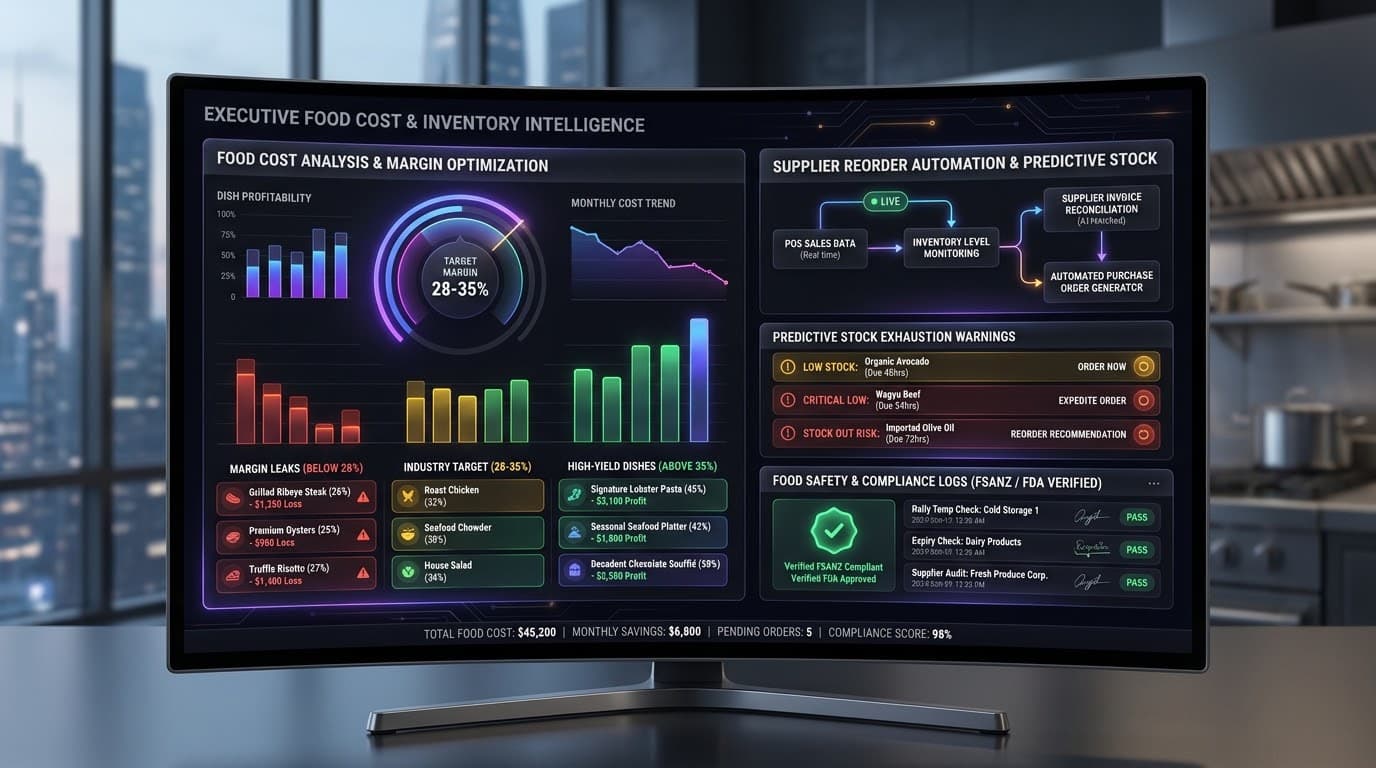
Running out of a key menu item on a Saturday night is a service failure that costs you not just the revenue from that table, but the repeat visit. Over-ordering the same item the following week erodes the margin you were trying to protect.
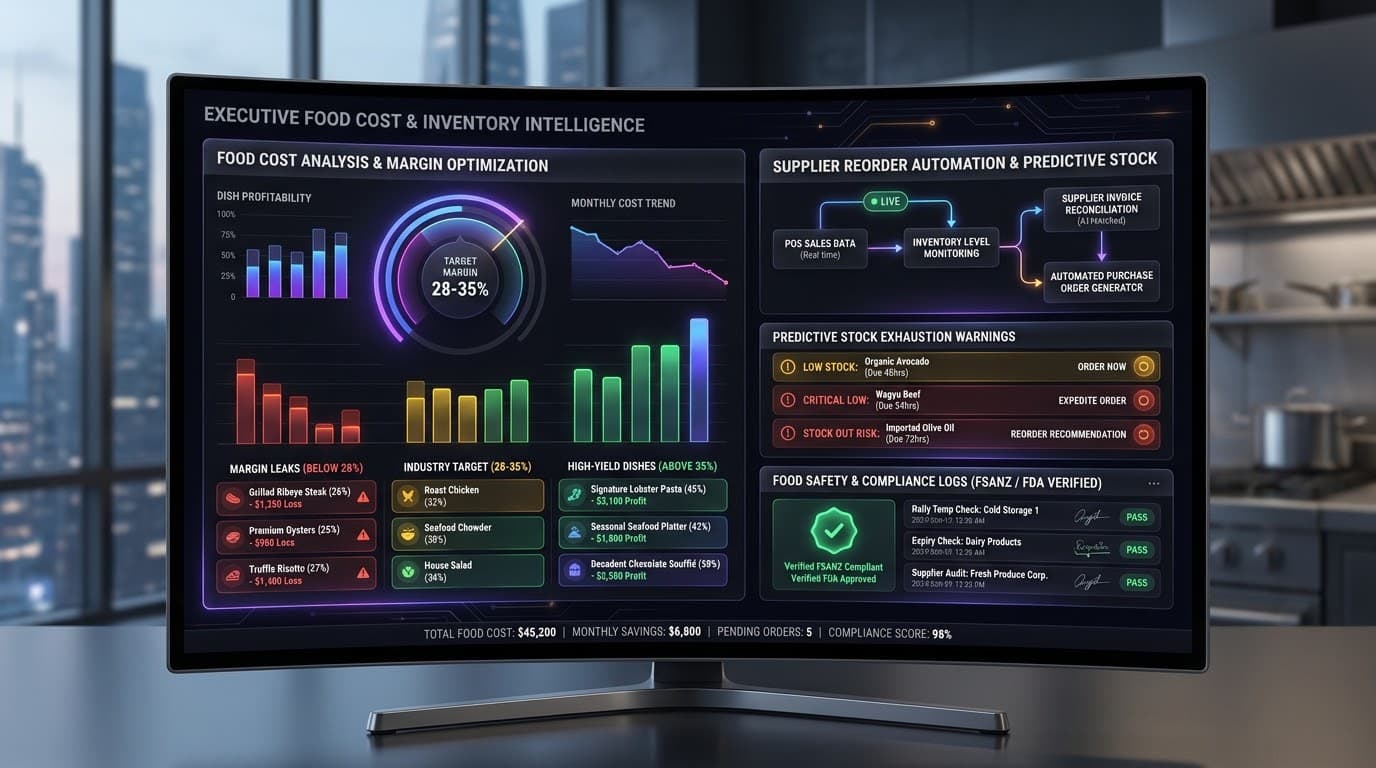
The workflow: AI connects to your POS sales data, tracks ingredient consumption against your recipes, predicts reorder quantities based on upcoming bookings and seasonal patterns, and either generates a purchase order automatically or flags the recommendation for owner approval. The system accounts for the difference between a quiet Tuesday and a Mother's Day weekend.
- Food cost percentage
- The share of revenue that leaves as ingredient cost — the P&L line where ordering accuracy shows up. For most independent venues it sits at 28–35%, which means every 1% of over-ordering is a 1% margin hit at the bottom of the statement.
Small improvements in ordering accuracy compound quickly at that level of the P&L.
There is a food safety dimension here as well. Accurate inventory tracking supports stock rotation records, which FSANZ in Australia, the FDA in the US, and the FSA in the UK all require operators to maintain. Some AI inventory tools generate these records automatically as a by-product of normal operation. This is informational context only — operators should verify their specific compliance obligations with relevant authorities or a food safety professional. Food Standards Australia New Zealand is the reference point for AU venues.
6. Menu Update Automation and Seasonal Pricing
Seasonal menu changes are a content problem as much as a culinary one. Every time the menu changes, the website needs updating, the Google Business Profile needs to reflect it, the online ordering platform needs new items, and social media needs a post announcing it. Done manually, this is a half-day task. Done with AI, it is a 20-minute approval process.
The workflow: the chef finalises the seasonal change, AI rewrites the menu descriptions in the venue's established brand voice, and pushes the updated content to the website CMS, Google Business Profile, and online ordering platform simultaneously. A social caption is drafted from the same input.
There is also a pricing signal available here. AI can cross-reference your current supplier invoices with your menu's food cost calculations and flag which items are running below your target margin. The decision on whether to adjust pricing stays with the owner — the tool just surfaces the information faster.
Square for Restaurants and Lightspeed both support bulk menu updates via API, which AI tools can trigger. Many independent venues start here because the barrier is low: menu description writing with a ChatGPT-style tool connected to your CMS is one of the simplest AI implementations available. One important note: AI-generated descriptions still need human review before publishing. Brand voice accuracy and factual correctness are both owner responsibilities.
7. Social Media Content Generation from Your Menu and Daily Specials
Most independent venue owners know they should be posting more consistently. The reason they are not is almost never a lack of content — it is the daily cost of stopping mid-service to think of something worth saying. AI removes that friction.
The workflow: today's specials are entered into the POS or dropped into a brief AI prompt, the tool generates three caption options for Instagram and Facebook, the owner picks one and edits if needed, and it is scheduled. Total time: under five minutes if the voice prompt is set up correctly.
Tools like Later, Buffer, and Metricool now include built-in AI caption generators. Standalone tools like ChatGPT work equally well with a saved prompt template that defines the venue's voice, any regular hashtags, and the tone you want for different post types.
One honest boundary: AI can write a good caption. It cannot take a good food photo. The image still needs a human. But the caption, the scheduling, and the posting cadence are all automatable.
Invest 30 minutes once to write a solid voice prompt — your tone, your regulars' language, what you never say — and the output quality scales from there.
8. Local Marketing Campaigns and Food Cost Analysis — The Two That Move the Needle
Local marketing automation
Most independent venues have customer data sitting unused in their POS. AI can turn that data into a targeted local marketing campaign without a marketing hire.
The workflow: AI analyses customer records by postcode, visit frequency, and order history, then generates a targeted offer for customers within a defined radius. That offer is distributed via a Google Ads local campaign or a Meta local awareness ad, both of which have AI-assist built in to their campaign tools. Doshii can feed purchase data directly into campaign audiences for AU operators.
Seasonal applications are strong here. Valentine's Day, Mother's Day, school holidays, local events, footy finals — AI drafts the campaign brief and the ad copy, the owner approves, and the campaign runs. This is AI for local marketing applied at the venue level, and it is within reach for a single-site operator without an agency.
Food cost analysis
Every venue owner knows which dish is popular. Fewer know which dish is quietly eating their margin. AI pulls your POS sales data and supplier invoices together, calculates the food cost percentage per dish, flags the items performing below your target margin, and surfaces menu engineering recommendations.
This is not a replacement for your accountant. It is the clarity layer between your monthly reports — the information that lets you make a menu decision in week two rather than finding out the damage in week five. It is one of the more commercially direct applications of AI for restaurants.
Ready to map out your venue's AI setup? No obligation.
Book a no-obligation conversation with a hospitality AI specialist.
What to Look for When Choosing AI Tools — and What to Avoid
Getting the first AI tool selection right matters more than most vendor conversations suggest. Here is the practical evaluation framework.
Look for:
- Integration with your existing POS. Tools that connect to Square, Lightspeed, Clover, or Toast without requiring you to change systems are the baseline. If the tool does not integrate, the workflow breaks.
- Setup measured in hours, not weeks. Independent venues do not have IT staff. If the onboarding process requires a dedicated technical resource, it is the wrong tool.
- No requirement to migrate your POS. Any vendor requiring a full POS switch to unlock AI features is asking you to make a much larger change than the one you signed up for.
- A clear data privacy and GDPR compliance position. For any tool that handles customer loyalty data or PII, ask for their data processing agreement before committing.
- Flat monthly pricing. Per-transaction pricing models erode margin as your volume grows. Flat-rate models protect you.
Avoid:
- Tools that describe themselves as AI but are running keyword triggers or basic IF/THEN logic. Ask directly what the underlying model is.
- Vendors with no hospitality-specific case studies or references. General small-business AI tools often fail on the edge cases that are standard in hospitality: alcohol licensing, allergen menus, split-bill bookings.
- Free tools with no data processing agreement when you are feeding them customer data. The risk sits with you, not the vendor.
If you are unsure where to start, a scoping conversation with a hospitality AI specialist is a practical first step before committing to any platform stack.
Conclusion
AI for cafes and restaurants is no longer an enterprise tool. The ten workflows covered here — automated review replies, staff scheduling, table booking chatbots, AI loyalty programs, supplier reorder automation, menu update automation, social media content generation, local marketing campaigns, food cost analysis, and AI tool evaluation — are all accessible to a single-site independent venue today.
None of them require a tech team. None require months of onboarding. None require you to replace your existing POS system.
The right starting point is one workflow. Pick the task that costs you the most time or money right now, check your POS integration options, and start there. If you want help mapping the right entry point for your specific venue, the Bizkook AI consulting team works with independent operators to do exactly that.
Watch: the ten workflows in six minutes
The Bizkook team walks through the ten workflows on a Sydney cafe — the actual dashboards, live POS data, and where each tool sits in the day. Same method as above, worked out loud.
 6:12
6:12Chapters
- 0:00Why independent venues need AI now
- 0:55Review replies + Google Business Profile
- 1:50Staff scheduling with 7shifts + Square POS
- 2:50Table booking chatbot on Instagram + web
- 3:55Loyalty programs that actually retain
- 5:00Choosing your first workflow — where to start
In summary
Ten contained workflows, one POS you already run, and no tech team required. Start with the workflow that costs you the most time today — usually review replies or scheduling — get it running well, then add the next. AI handles the volume; your team keeps the judgement calls.
Get your AI Tune ScoreYou know what you need. Let us work out how to get there.
Bizkook works with independent cafes and restaurants to design and implement AI workflows that fit your existing systems — without the enterprise price tag.
Common questions
Answered directly, so they can be quoted without the surrounding argument.
AI for restaurants refers to practical automation tools that handle specific operational tasks: scheduling, chatbots, review management, loyalty programs, inventory ordering, menu updates, and local marketing. It is not robots or science fiction. It is software that connects to your existing POS and automates the repetitive work so your team can focus on service.
How this piece was produced
Written by the Bizkook team based on direct experience working with Australian hospitality operators on AI implementation. Reviewed and edited by the Bizkook team before publication. Published August 2023.